Mitochondrial ornithine transporter 1 (Solute carrier family 25 member 15)
1_MKSNP 6_ AIQAA 11_ IDLTA 16_ GAAGG 21_ TACVL 26_ TGQPF 31_ DTMKV 36_ KMQTF 41_ PDLYR 46_ GLTDC 51_ CLKTY 56_ SQVGF 61_ RGFYK 66_ GTSPA 71_ LIANI 76_ AENSV 81_ LFMCY 86_ GFCQQ 91_ VVRKV 96_ AGLDK 101_ QAKLS 106_ DLQNA 111_ AAGSF 116_ ASAFA 121_ ALVLC 126_ PTELV 131_ KCRLQ 136_ TMYEM 141_ ETSGK 146_ IAKSQ 151_ NTVWS 156_ VIKSI 161_ LRKDG 166_ PLGFY 171_ HGLSS 176_ TLLRE 181_ VPGYF 186_ FFFGG 191_ YELSR 196_ SFFAS 201_ GRSKD 206_ ELGPV 211_ PLMLS 216_ GGVGG 221_ ICLWL 226_ AVYPV 231_ DCIKS 236_ RIQVL 241_ SMSGK 246_ QAGFI 251_ RTFIN 256_ VVKNE 261_ GITAL 266_ YSGLK 271_ PTMIR 276_ AFPAN 281_ GALFL 286_ AYEYS 291_ RKLMM 296_NQLEA
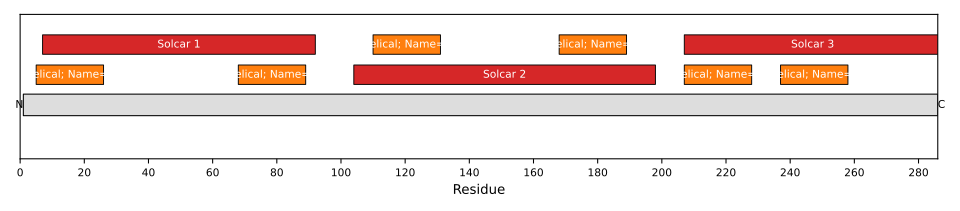
1: Mitochondrial ornithine-citrulline antiporter (Probable) (PubMed:12807890, PubMed:22262851). Catalyzes the exchange between cytosolic ornithine and mitochondrial citrulline plus an H(+), the proton compensates the positive charge of ornithine thus leading to an electroneutral transport. Plays a crucial role in the urea cycle, by connecting the cytosolic and the intramitochondrial reactions of the urea cycle (Probable) (PubMed:12807890, PubMed:22262851). Lysine and arginine are also transported by the antiport mechanism (Probable) (PubMed:12807890). In addition, catalyzes an electroneutral exchange of ornithine or lysine for H(+), a reaction driven by the pH gradient across the inner membrane (By similarity)