Adhesion G-protein coupled receptor G1 (G-protein coupled receptor 56) (Protein TM7XN1) [Cleaved into: ADGRG1 N-terminal fragment (ADGRG1 NT) (GPR56 N-terminal fragment) (GPR56 NT) (GPR56(N)) (GPR56 extracellular subunit) (GPR56 subunit alpha); ADGRG1 C-terminal fragment (ADGRG1 CT) (GPR56 C-terminal fragment) (GPR56 CT) (GPR56(C)) (GPR56 seven-transmembrane subunit) (GPR56 7TM) (GPR56 subunit beta)]
1_MTPQS 6_ LLQTT 11_ LFLLS 16_ LLFLV 21_ QGAHG 26_ RGHRE 31_ DFRFC 36_ SQRNQ 41_ THRSS 46_ LHYKP 51_ TPDLR 56_ ISIEN 61_ SEEAL 66_ TVHAP 71_ FPAAH 76_ PASRS 81_ FPDPR 86_ GLYHF 91_ CLYWN 96_ RHAGR 101_ LHLLY 106_ GKRDF 111_ LLSDK 116_ ASSLL 121_ CFQHQ 126_ EESLA 131_ QGPPL 136_ LATSV 141_ TSWWS 146_ PQNIS 151_ LPSAA 156_ SFTFS 161_ FHSPP 166_ HTAAH 171_ NASVD 176_ MCELK 181_ RDLQL 186_ LSQFL 191_ KHPQK 196_ ASRRP 201_ SAAPA 206_ SQQLQ 211_ SLESK 216_ LTSVR 221_ FMGDM 226_ VSFEE 231_ DRINA 236_ TVWKL 241_ QPTAG 246_ LQDLH 251_ IHSRQ 256_ EEEQS 261_ EIMEY 266_ SVLLP 271_ RTLFQ 276_ RTKGR 281_ SGEAE 286_ KRLLL 291_ VDFSS 296_ QALFQ 301_ DKNSS 306_ QVLGE 311_ KVLGI 316_ VVQNT 321_ KVANL 326_ TEPVV 331_ LTFQH 336_ QLQPK 341_ NVTLQ 346_ CVFWV 351_ EDPTL 356_ SSPGH 361_ WSSAG 366_ CETVR 371_ RETQT 376_ SCFCN 381_ HLTYF 386_ AVLMV 391_ SSVEV 396_ DAVHK 401_ HYLSL 406_ LSYVG 411_ CVVSA 416_ LACLV 421_ TIAAY 426_ LCSRV 431_ PLPCR 436_ RKPRD 441_ YTIKV 446_ HMNLL 451_ LAVFL 456_ LDTSF 461_ LLSEP 466_ VALTG 471_ SEAGC 476_ RASAI 481_ FLHFS 486_ LLTCL 491_ SWMGL 496_ EGYNL 501_ YRLVV 506_ EVFGT 511_ YVPGY 516_ LLKLS 521_ AMGWG 526_ FPIFL 531_ VTLVA 536_ LVDVD 541_ NYGPI 546_ ILAVH 551_ RTPEG 556_ VIYPS 561_ MCWIR 566_ DSLVS 571_ YITNL 576_ GLFSL 581_ VFLFN 586_ MAMLA 591_ TMVVQ 596_ ILRLR 601_ PHTQK 606_ WSHVL 611_ TLLGL 616_ SLVLG 621_ LPWAL 626_ IFFSF 631_ ASGTF 636_ QLVVL 641_ YLFSI 646_ ITSFQ 651_ GFLIF 656_ IWYWS 661_ MRLQA 666_ RGGPS 671_ PLKSN 676_ SDSAR 681_ LPISS 686_GSTSS
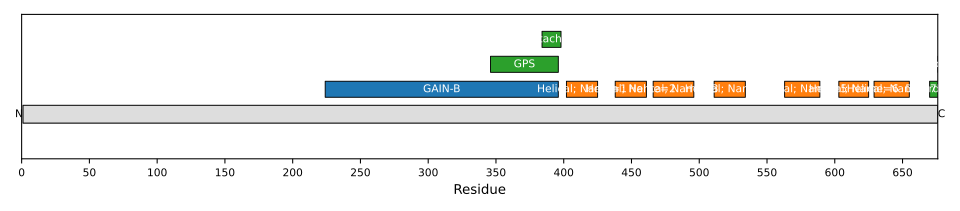
1: Adhesion G-protein coupled receptor (aGPCR) for steroid hormone 17alpha-hydroxypregnenolone (17-OH), which is involved in cell adhesion and cell-cell interactions (PubMed:39389061). Ligand binding causes a conformation change that triggers signaling via guanine nucleotide-binding proteins (G proteins) and modulates the activity of downstream effectors, such as RhoA pathway (PubMed:28874577, PubMed:35418682, PubMed:39389061). ADGRG1 is coupled to G(12) and/or G(13) G proteins (GNA12 and GNA13, respectively) and mediates the activation Rho small GTPases (PubMed:22238662, PubMed:28424266, PubMed:35418682, PubMed:39389061). Acts as a potent suppressor of ferroptosis: binding to 17-OH-binding initiates signaling that down-regulates CD36 and alleviates ferroptosis-induced liver injury (By similarity). Ligand-binding also induces cell adhesion activity via association with proteins such as collagen III/COL3A1 and TGM2 (By similarity). Mediates cell matrix adhesion in developing neurons and hematopoietic stem cells (By similarity). Involved in cortical development, specifically in maintenance of the pial basement membrane integrity and in cortical lamination: association with COL3A1 in the developing brain inhibits neuronal migration via activation of the RhoA pathway (PubMed:24531968). Together with TGM2, acts as a regulator of myelination and myelin repair in oligodendrocyte precursor cells (By similarity). Acts as a hemostatic sensor of shear force: G protein-coupled receptor signaling is activated in response to shear force in platelets, promoting G(13) G protein signaling, and platelet shape change and aggregation in a COL3A1-dependent manner (PubMed:33097663). Acts as an inhibitor of VEGFA production thereby inhibiting angiogenesis through a signaling pathway mediated by PRKCA (PubMed:16757564, PubMed:19572147, PubMed:21724588). Plays a role in the maintenance of hematopoietic stem cells in bone marrow niche (By similarity). Plays an essential role in testis development (By similarity)