Protein mono-ADP-ribosyltransferase PARP3 (EC 2.4.2.-) (ADP-ribosyltransferase diphtheria toxin-like 3) (ARTD3) (DNA ADP-ribosyltransferase PARP3) (EC 2.4.2.-) (IRT1) (NAD(+) ADP-ribosyltransferase 3) (ADPRT-3) (Poly [ADP-ribose] polymerase 3) (PARP-3) (hPARP-3) (Poly[ADP-ribose] synthase 3) (pADPRT-3)
1_MAPKP 6_ KPWVQ 11_ TEGPE 16_ KKKGR 21_ QAGRE 26_ EDPFR 31_ STAEA 36_ LKAIP 41_ AEKRI 46_ IRVDP 51_ TCPLS 56_ SNPGT 61_ QVYED 66_ YNCTL 71_ NQTNI 76_ ENNNN 81_ KFYII 86_ QLLQD 91_ SNRFF 96_ TCWNR 101_ WGRVG 106_ EVGQS 111_ KINHF 116_ TRLED 121_ AKKDF 126_ EKKFR 131_ EKTKN 136_ NWAER 141_ DHFVS 146_ HPGKY 151_ TLIEV 156_ QAEDE 161_ AQEAV 166_ VKVDR 171_ GPVRT 176_ VTKRV 181_ QPCSL 186_ DPATQ 191_ KLITN 196_ IFSKE 201_ MFKNT 206_ MALMD 211_ LDVKK 216_ MPLGK 221_ LSKQQ 226_ IARGF 231_ EALEA 236_ LEEAL 241_ KGPTD 246_ GGQSL 251_ EELSS 256_ HFYTV 261_ IPHNF 266_ GHSQP 271_ PPINS 276_ PELLQ 281_ AKKDM 286_ LLVLA 291_ DIELA 296_ QALQA 301_ VSEQE 306_ KTVEE 311_ VPHPL 316_ DRDYQ 321_ LLKCQ 326_ LQLLD 331_ SGAPE 336_ YKVIQ 341_ TYLEQ 346_ TGSNH 351_ RCPTL 356_ QHIWK 361_ VNQEG 366_ EEDRF 371_ QAHSK 376_ LGNRK 381_ LLWHG 386_ TNMAV 391_ VAAIL 396_ TSGLR 401_ IMPHS 406_ GGRVG 411_ KGIYF 416_ ASENS 421_ KSAGY 426_ VIGMK 431_ CGAHH 436_ VGYMF 441_ LGEVA 446_ LGREH 451_ HINTD 456_ NPSLK 461_ SPPPG 466_ FDSVI 471_ ARGHT 476_ EPDPT 481_ QDTEL 486_ ELDGQ 491_ QVVVP 496_ QGQPV 501_ PCPEF 506_ SSSTF 511_ SQSEY 516_ LIYQE 521_ SQCRL 526_RYLLE
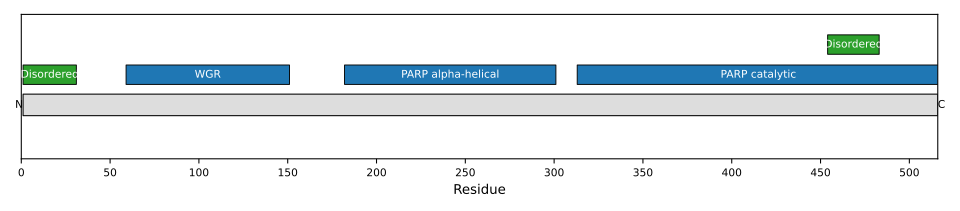
1: Mono-ADP-ribosyltransferase that mediates mono-ADP-ribosylation of target proteins and plays a key role in the response to DNA damage (PubMed:16924674, PubMed:19354255, PubMed:20064938, PubMed:21211721, PubMed:21270334, PubMed:23742272, PubMed:24598253, PubMed:25043379, PubMed:28447610). Mediates mono-ADP-ribosylation of glutamate, aspartate or lysine residues on target proteins (PubMed:20064938, PubMed:25043379). In contrast to PARP1 and PARP2, it is not able to mediate poly-ADP-ribosylation (PubMed:25043379). Involved in DNA repair by mediating mono-ADP-ribosylation of a limited number of acceptor proteins involved in chromatin architecture and in DNA metabolism, such as histone H2B, XRCC5 and XRCC6 (PubMed:16924674, PubMed:24598253). ADP-ribosylation follows DNA damage and appears as an obligatory step in a detection/signaling pathway leading to the reparation of DNA strand breaks (PubMed:16924674, PubMed:21211721, PubMed:21270334). Involved in single-strand break repair by catalyzing mono-ADP-ribosylation of histone H2B on 'Glu-2' (H2BE2ADPr) of nucleosomes containing nicked DNA (PubMed:27530147). Cooperates with the XRCC5-XRCC6 (Ku80-Ku70) heterodimer to limit end-resection thereby promoting accurate NHEJ (PubMed:24598253). Suppresses G-quadruplex (G4) structures in response to DNA damage (PubMed:28447610). Associates with a number of DNA repair factors and is involved in the response to exogenous and endogenous DNA strand breaks (PubMed:16924674, PubMed:21211721, PubMed:21270334). Together with APLF, promotes the retention of the LIG4-XRCC4 complex on chromatin and accelerate DNA ligation during non-homologous end-joining (NHEJ) (PubMed:21211721). May link the DNA damage surveillance network to the mitotic fidelity checkpoint (PubMed:16924674). Acts as a negative regulator of immunoglobulin class switch recombination, probably by controlling the level of AICDA /AID on the chromatin (By similarity). In addition to proteins, also able to ADP-ribosylate DNA: mediates DNA mono-ADP-ribosylation of DNA strand break termini via covalent addition of a single ADP-ribose moiety to a 5'- or 3'-terminal phosphate residues in DNA containing multiple strand breaks (PubMed:29361132, PubMed:29520010)