Testis-expressed protein 264 (Putative secreted protein Zsig11)
1_MSDLL 6_ LLGLI 11_ GGLTL 16_ LLLLT 21_ LLAFA 26_ GYSGL 31_ LAGVE 36_ VSAGS 41_ PPIRN 46_ VTVAY 51_ KFHMG 56_ LYGET 61_ GRLFT 66_ ESCSI 71_ SPKLR 76_ SIAVY 81_ YDNPH 86_ MVPPD 91_ KCRCA 96_ VGSIL 101_ SEGEE 106_ SPSPE 111_ LIDLY 116_ QKFGF 121_ KVFSF 126_ PAPSH 131_ VVTAT 136_ FPYTT 141_ ILSIW 146_ LATRR 151_ VHPAL 156_ DTYIK 161_ ERKLC 166_ AYPRL 171_ EIYQE 176_ DQIHF 181_ MCPLA 186_ RQGDF 191_ YVPEM 196_ KETEW 201_ KWRGL 206_ VEAID 211_ TQVDG 216_ TGADT 221_ MSDTS 226_ SVSLE 231_ VSPGS 236_ RETSA 241_ ATLSP 246_ GASSR 251_ GWDDG 256_ DTRSE 261_ HSYSE 266_ SGASG 271_ SSFEE 276_ LDLEG 281_ EGPLG 286_ ESRLD 291_ PGTEP 296_ LGTTK 301_ WLWEP 306_TAPEK
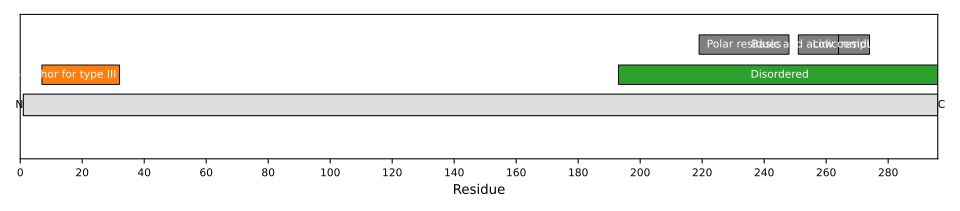
1: Major reticulophagy (also called ER-phagy) receptor that acts independently of other candidate reticulophagy receptors to remodel subdomains of the endoplasmic reticulum into autophagosomes upon nutrient stress, which then fuse with lysosomes for endoplasmic reticulum turnover (PubMed:31006537, PubMed:31006538). The ATG8-containing isolation membrane (IM) cradles a tubular segment of TEX264-positive ER near a three-way junction, allowing the formation of a synapse of 2 juxtaposed membranes with trans interaction between the TEX264 and ATG8 proteins (PubMed:31006537). Expansion of the IM would extend the capture of ER, possibly through a 'zipper-like' process involving continued trans TEX264-ATG8 interactions, until poorly understood mechanisms lead to the fission of relevant membranes and, ultimately, autophagosomal membrane closure (PubMed:31006537). Also involved in the repair of covalent DNA-protein cross-links (DPCs) during DNA synthesis: acts by bridging VCP/p97 to covalent DNA-protein cross-links (DPCs) and initiating resolution of DPCs by SPRTN (PubMed:32152270)