Solute carrier organic anion transporter family member 1B1 (Liver-specific organic anion transporter 1) (LST-1) (OATP-C) (Sodium-independent organic anion-transporting polypeptide 2) (OATP-2) (Solute carrier family 21 member 6)
1_MDQNQ 6_ HLNKT 11_ AEAQP 16_ SENKK 21_ TRYCN 26_ GLKMF 31_ LAALS 36_ LSFIA 41_ KTLGA 46_ IIMKS 51_ SIIHI 56_ ERRFE 61_ ISSSL 66_ VGFID 71_ GSFEI 76_ GNLLV 81_ IVFVS 86_ YFGSK 91_ LHRPK 96_ LIGIG 101_ CFIMG 106_ IGGVL 111_ TALPH 116_ FFMGY 121_ YRYSK 126_ ETNIN 131_ SSENS 136_ TSTLS 141_ TCLIN 146_ QILSL 151_ NRASP 156_ EIVGK 161_ GCLKE 166_ SGSYM 171_ WIYVF 176_ MGNML 181_ RGIGE 186_ TPIVP 191_ LGLSY 196_ IDDFA 201_ KEGHS 206_ SLYLG 211_ ILNAI 216_ AMIGP 221_ IIGFT 226_ LGSLF 231_ SKMYV 236_ DIGYV 241_ DLSTI 246_ RITPT 251_ DSRWV 256_ GAWWL 261_ NFLVS 266_ GLFSI 271_ ISSIP 276_ FFFLP 281_ QTPNK 286_ PQKER 291_ KASLS 296_ LHVLE 301_ TNDEK 306_ DQTAN 311_ LTNQG 316_ KNITK 321_ NVTGF 326_ FQSFK 331_ SILTN 336_ PLYVM 341_ FVLLT 346_ LLQVS 351_ SYIGA 356_ FTYVF 361_ KYVEQ 366_ QYGQP 371_ SSKAN 376_ ILLGV 381_ ITIPI 386_ FASGM 391_ FLGGY 396_ IIKKF 401_ KLNTV 406_ GIAKF 411_ SCFTA 416_ VMSLS 421_ FYLLY 426_ FFILC 431_ ENKSV 436_ AGLTM 441_ TYDGN 446_ NPVTS 451_ HRDVP 456_ LSYCN 461_ SDCNC 466_ DESQW 471_ EPVCG 476_ NNGIT 481_ YISPC 486_ LAGCK 491_ SSSGN 496_ KKPIV 501_ FYNCS 506_ CLEVT 511_ GLQNR 516_ NYSAH 521_ LGECP 526_ RDDAC 531_ TRKFY 536_ FFVAI 541_ QVLNL 546_ FFSAL 551_ GGTSH 556_ VMLIV 561_ KIVQP 566_ ELKSL 571_ ALGFH 576_ SMVIR 581_ ALGGI 586_ LAPIY 591_ FGALI 596_ DTTCI 601_ KWSTN 606_ NCGTR 611_ GSCRT 616_ YNSTS 621_ FSRVY 626_ LGLSS 631_ MLRVS 636_ SLVLY 641_ IILIY 646_ AMKKK 651_ YQEKD 656_ INASE 661_ NGSVM 666_ DEANL 671_ ESLNK 676_ NKHFV 681_ PSAGA 686_DSETH
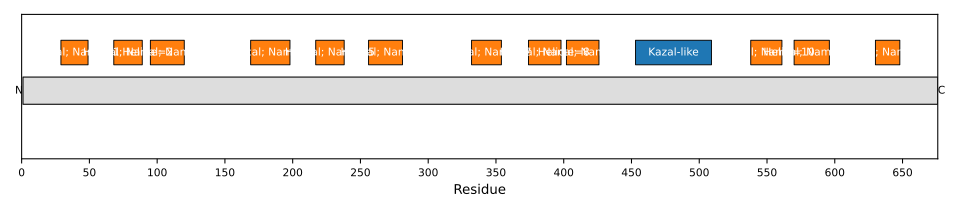
1: Mediates the Na(+)-independent uptake of organic anions (PubMed:10358072, PubMed:15159445, PubMed:17412826). Shows broad substrate specificity, can transport both organic anions such as bile acid taurocholate (cholyltaurine) and conjugated steroids (dehydroepiandrosterone 3-sulfate, 17-beta-glucuronosyl estradiol, and estrone 3-sulfate), as well as eicosanoids (prostaglandin E2, thromboxane B2, leukotriene C4, and leukotriene E4), and thyroid hormones (T4/L-thyroxine, and T3/3,3',5'-triiodo-L-thyronine) (PubMed:10358072, PubMed:10601278, PubMed:10873595, PubMed:11159893, PubMed:12196548, PubMed:12568656, PubMed:15159445, PubMed:15970799, PubMed:16627748, PubMed:17412826, PubMed:19129463, PubMed:26979622). Can take up bilirubin glucuronides from plasma into the liver, contributing to the detoxification-enhancing liver-blood shuttling loop (PubMed:22232210). Involved in the clearance of endogenous and exogenous substrates from the liver (PubMed:10358072, PubMed:10601278). Transports coproporphyrin I and III, by-products of heme synthesis, and may be involved in their hepatic disposition (PubMed:26383540). May contribute to regulate the transport of organic compounds in testes across the blood-testis-barrier (Probable). Can transport HMG-CoA reductase inhibitors (also known as statins), such as pravastatin and pitavastatin, a clinically important class of hypolipidemic drugs (PubMed:10601278, PubMed:15159445, PubMed:15970799). May play an important role in plasma and tissue distribution of the structurally diverse chemotherapeutic drug methotrexate (PubMed:23243220). May also transport antihypertension agents, such as the angiotensin-converting enzyme (ACE) inhibitor prodrug enalapril, and the highly selective angiotensin II AT1-receptor antagonist valsartan, in the liver (PubMed:16624871, PubMed:16627748). Shows a pH-sensitive substrate specificity towards prostaglandin E2 and T4 which may be ascribed to the protonation state of the binding site and leads to a stimulation of substrate transport in an acidic microenvironment (PubMed:19129463). Hydrogencarbonate/HCO3(-) acts as the probable counteranion that exchanges for organic anions (PubMed:19129463)