Sestrin-1 (EC 1.11.1.-) (p53-regulated protein PA26)
1_MRLAA 6_ AANEA 11_ YTAPL 16_ AVSGL 21_ LGCKQ 26_ CGGGR 31_ DQDEE 36_ LGIRI 41_ PRPLG 46_ QGPSR 51_ FIPEK 56_ EILQV 61_ GSEDA 66_ QMHAL 71_ FADSF 76_ AALGR 81_ LDNIT 86_ LVMVF 91_ HPQYL 96_ ESFLK 101_ TQHYL 106_ LQMDG 111_ PLPLH 116_ YRHYI 121_ GIMAA 126_ ARHQC 131_ SYLVN 136_ LHVND 141_ FLHVG 146_ GDPKW 151_ LNGLE 156_ NAPQK 161_ LQNLG 166_ ELNKV 171_ LAHRP 176_ WLITK 181_ EHIEG 186_ LLKAE 191_ EHSWS 196_ LAELV 201_ HAVVL 206_ LTHYH 211_ SLASF 216_ TFGCG 221_ ISPEI 226_ HCDGG 231_ HTFRP 236_ PSVSN 241_ YCICD 246_ ITNGN 251_ HSVDE 256_ MPVNS 261_ AENVS 266_ VSDSF 271_ FEVEA 276_ LMEKM 281_ RQLQE 286_ CRDEE 291_ EASQE 296_ EMASR 301_ FEIEK 306_ RESMF 311_ VFSSD 316_ DEEVT 321_ PARAV 326_ SRHFE 331_ DTSYG 336_ YKDFS 341_ RHGMH 346_ VPTFR 351_ VQDYC 356_ WEDHG 361_ YSLVN 366_ RLYPD 371_ VGQLI 376_ DEKFH 381_ IAYNL 386_ TYNTM 391_ AMHKD 396_ VDTSM 401_ LRRAI 406_ WNYIH 411_ CMFGI 416_ RYDDY 421_ DYGEI 426_ NQLLD 431_ RSFKV 436_ YIKTV 441_ VCTPE 446_ KVTKR 451_ MYDSF 456_ WRQFK 461_ HSEKV 466_ HVNLL 471_ LIEAR 476_ MQAEL 481_ LYALR 486_AITRY
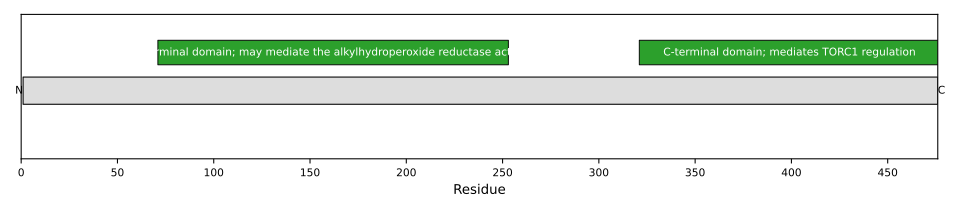
1: Functions as an intracellular leucine sensor that negatively regulates the TORC1 signaling pathway through the GATOR complex. In absence of leucine, binds the GATOR subcomplex GATOR2 and prevents TORC1 signaling. Binding of leucine to SESN2 disrupts its interaction with GATOR2 thereby activating the TORC1 signaling pathway (PubMed:25263562, PubMed:26449471). This stress-inducible metabolic regulator may also play a role in protection against oxidative and genotoxic stresses (By similarity). May positively regulate the transcription by NFE2L2 of genes involved in the response to oxidative stress by facilitating the SQSTM1-mediated autophagic degradation of KEAP1 (PubMed:23274085). Moreover, may prevent the accumulation of reactive oxygen species (ROS) through the alkylhydroperoxide reductase activity born by the N-terminal domain of the protein (By similarity). Was originally reported to contribute to oxidative stress resistance by reducing PRDX1 (PubMed:15105503). However, this could not be confirmed (By similarity)